


At the recent Turning the Tide conference in New York we announced the Project for 9/11 Truth and Accountability (PTA). The Project was formed earlier this year following U.S. Senator Ron Johnson’s invitation to submit a report on 9/11 to the Senate Permanent Subcommittee on Investigations. The Project’s purpose is to pursue legislative and legal means of establishing a complete, accurate, and evidence-based account of the events of September 11, 2001, and to advance appropriate measures for achieving justice and accountability.
Drawing on 25 years of research, the report we are preparing will provide a comprehensive accounting of what did and did not happen on 9/11 — to the extent that the evidence allows — and will lay the informational foundation for a new investigation with meaningful legal powers. The Report outline can be read here.

At Turning the Tide we presented some of the material being worked for inclusion in the report:- Richard Gage, AIA - Architect on the destruction of the buildings in New York, Allan Merrill on the alleged hijackers and US intelligence, and my work on the 9/11 flights.
The talks, plus Mick Harrison’s introduction and comments from Senator Ron Johnson (see Dr Mary Holland’s talk), can all be viewed here:
My presentation can be watched here and the presentation notes are also available below.

Anomalies in the Air: Critical Scrutiny of the Alleged Hijacking Events and the Official Narrative of the Air Defense Failures
Presentation notes:
Thank you for the kind introduction.
What happened in the skies is a critical component of the 9/11 narrative.
As we all know, the 9/11 Commission claims that 4 teams of hijackers commandeered four airliners, and then successfully navigated three of them toward their targets, striking the Twin Towers here in New York as well as the Pentagon near Washington D.C.
SLIDE 2
However, we now know beyond reasonable doubt that the destruction of the buildings in New York was pre-planned. The aircraft themselves simply served the purpose of providing cover for this destruction by creating the illusion that their impacts had caused damage and fire sufficient to trigger a gravitational collapse.
Without these impacts there would have been no plausible explanation for the destruction of the buildings, and the perpetrators’ plan – to blame the shock and awe and mass casualties from the collapse of the buildings on middle eastern terrorist hijackers as a pretext for war – would have come undone in a most spectacular fashion.
Guaranteeing the aircraft impacts was therefore essential for the planners of 9/11.
We can draw an important logical inference from this:
The planners would not have risked the success of the operation by relying on teams of hijackers to:
First) successfully board the aircraft
Second) forcibly take control from the pilots
Third) navigate the aircraft to and hit the buildings
and
Fourth) not back out of the intention to commit suicide at any point during this process
Furthermore, the planners would have needed to guarantee the aircraft would not be intercepted by the US air force. Simply creating confusion and hoping for no successful intercepts would not have sufficed. A plan would have needed to be in place in order to prevent any possible interception.
In short, a highly controlled scenario would have been necessary in order to guarantee the all-important plane impacts.
With this logical inference in mind, I want to provide you with a snapshot of three areas of inquiry currently underway into the 9/11 aviation events. This work is being done for the forthcoming report from the Project for 9/11 Truth and Accountability.
The first area concerns critical evaluation of the alleged takeovers, and here I will outline recent analysis of some of the communications from the aircraft which brings into question the official account of the aircraft takeovers.
The second area concerns the control of the flights and evidence that they were under some combination of automated/remote control and precision guidance.
The third area concerns information regarding actions that hobbled the US air defence system and ensured there were no interceptions.
I will be discussing each area in turn.
SLIDE 3
The hijacking narrative – that the aircraft were taken over by the alleged hijackers by force – is the first and most essential step in the official story. Critically, this component of the narrative relies heavily, if not entirely, on communications from some of the alleged hijackers, flight attendants, and passengers.
Much has been said about these communications, for example by the 9/11 Consensus Panel headed by Professor David Ray Griffin and Elizabeth Woodworth.
Our review of existing research, along with our own, has identified a series of anomalies and inconsistencies and I want to flag up two areas.
The first concerns communications from American Airlines Flight 11, the first airliner to be commandeered, and the transmission which purportedly came from alleged hijacker pilot Mohammed Atta. The second concerns communications from two of the flight attendants.
I’ll play you first the transmissions in question from Atta
SLIDES 4 & 5 Play clips:
Forensic linguist Professor Natalie Schilling, a Fellow of the Linguistic Society of America, analysed these communications, and she identified several linguistic features inconsistent with what would normally be expected of a native Arabic speaker speaking English.
SLIDE 6
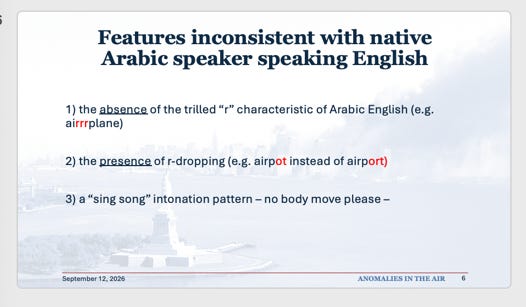
Specifically, she identified:
a) the absence of the trilled “r” – Rrrrr instead of R –which is characteristic of Arabic English
b) the presence of r-dropping (airpot instead of airport)
and
c), a “sing song” intonation pattern which is more consistent with certain Caribbean English dialects or, less so, with West African English varieties such as Ghanaian or Nigerian English.
Importantly, she also established that Atta’s reported language exposures do not account for him having adopted an accent more consistent with Caribbean or West African varieties of English.
I’ll play those clips again to let you try and pick out those features
SLIDES 7 and 8
I strongly recommend reading the full report which is available for free on the IC911 website.
Overall, Schilling concluded that her findings “raise doubt that the native language of the AA11 speaker is Arabic.”
Clearly, this evidence brings in to doubt the official claim that Mohammed Atta was at the controls of AA11, and this dovetails with Allan Merril’s analysis that we heard earlier.
The second area I want to highlight concerns communications from two of AA11’s flight attendants – Betty Ong and Madeline Sweeney.
SLIDE 9
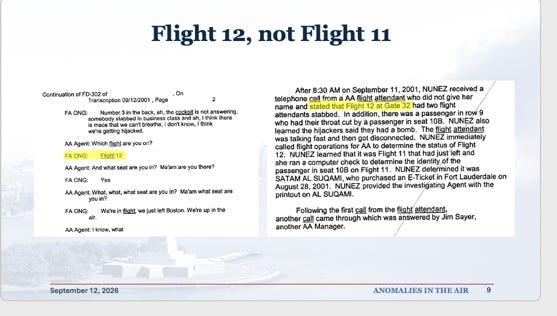
Both of these attendants started their calls by stating that they were on Flight 12, not Flight 11. This, in and of itself, is a remarkable mistake for two professionals trained to report accurate information in an emergency situation. The fact that the mistake occurred twice raises the possibility that the two flight attendants were not reporting an ongoing hijack on Flight 11.
Furthermore, Sweeney’s first call commenced by stating that “Flight 12 at Gate 32 had two flight attendants stabbed” i.e. suggesting that they were not airborne. She also failed to identify herself, as was also the case when she spoke to a second American Airlines employee at Boston Logan minutes later.
SLIDE 10
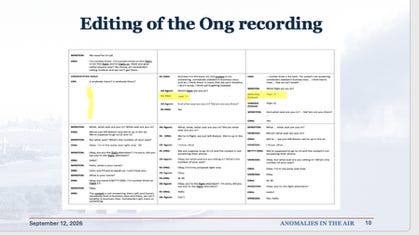
We also know that Ong’s call was edited on the day of 9/11 and that mention of her Flight 12 utterance was initially removed: You can see the removal and then replacement of “Flight 12” across a series of transcripts in slide 10.
It is possible that those editing the tape realised that Ong’s “Flight 12” utterance at the start of the call had to be added back in subsequent transcripts so as to make sense of Flight 12 being mentioned one time later in the call.
Also, four phone calls were made by an unknown individual to the childhood home of flight attendant Sara Low.
SLIDE 11
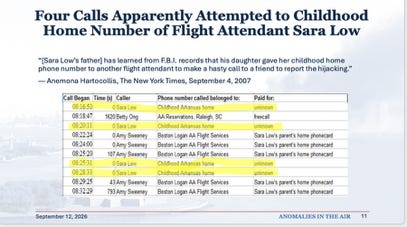
This was a defunct number and there is no apparent reason why a flight attendant, seeking to communicate critical information about a hijacking, would use this number.
One possible explanation here is that Sara Low did not actually wish to reach her family but was required to make phone calls, and so she dialled a number she knew was defunct.
Another possible explanation is that someone seeking to impersonate Low made those calls without being aware that this phone number was outdated.
A third explanation may be that the stress of the situation caused her to mistakenly call her childhood home number, although this is hard to reconcile with the fact that she called her parents routinely and that the same defunct number was called four times.
Another matter concerns the implausibility of some of the descriptions provided of events on the plane
Specifically, neither Ong nor Sweeney provided any information regarding the purported violent takeover of the plane, whilst both reported only two to three hijackers when the official story asserts there were five. Even if they did not directly witness the violent encounters and cockpit invasion, according to the circumstances they described there would have been opportunity for other flight attendants and passengers to inform them of the number of hijackers.
Furthermore, according to Ong and Sweeney, there were no hijackers in the cabin after the cockpit invasion. This would have required that all five hijackers crowded into the cockpit together with the incapacitated pilots.
Also, coach passengers were described as being unaware of the situation despite it being reported that mace was in the air, three knife attacks had occurred, and that 1st/business class passengers were coming back to coach, where Ong and Sweeney were stationed.
Finally, Ong stated that she was in a jump seat, from which it appears an air phone call would have been impossible, and yet air phone records exist of her call!
Summing up this section on the communications:
These are not trivial inconsistencies or anomalies and there are more pertaining to all four flights which we are currently evaluating. This information raises substantial doubt regarding the authenticity or accuracy of at least some of the communications on 9/11. And, if some were not authentic or accurate, then substantial doubt is raised about the veracity of the official hijacking narrative.
SLIDE 12
Questions surrounding the control of the 9/11 flights have persisted for over two decades and many doubt the official story that the planes were actually flown by hijackers.
For example, one oft-repeated issue concerns the piloting ability of Hani Hanjour, the individual alleged to have piloted American Airlines 77.
Reports from flight instructors indicated that he was not a competent pilot and questioned whether he would have possessed the piloting skills necessary to crash a 757 at very high speed into the Pentagon.
Indeed, the 9/11 Consensus panel concluded that Hanjour could not have piloted that plane.
More generally, many highly experienced pilots have expressed their doubts that any of the aircraft that impacted targets on 9/11 could have been manually flown.
These debates raise the question of whether the aircraft were under some form of automated or remote-control involving computer-aided precision guidance. This scenario is consistent with the logical inference discussed at the start of this presentation concerning the need for planners to have a high level of control over events in order to ensure the all-important aircraft impacts occurred as planned.
The 9/11 Commission itself claimed that the alleged hijacker pilots possessed sufficient training to fly the planes. However, the Commission’s records do not show that it conducted a detailed examination of these flights, the paths they took, and the maneuvers they performed. This was a serious short coming that avoided close examination of information which, as we shall see, provides support for the automated/remote/computer assisted control scenario.
The focus of the work here has been to examine what can be established about these flight paths and maneuvers empirically and then, drawing upon this, make inferences to the best explanation.
For example, one area which I want to highlight today concerns examination of the final flight tracks and maneuvers seen on 9/11. Because of time, I’m going to focus on the flights that impacted the Towers and I will not be discussing in depth the Pentagon case.
What do we know about these tracks and maneuvers?
SLIDE 13
First, examining a combination of radar data, film recordings, and the impact damage on the buildings, we can see that the aircraft were not flown directly at the Towers during the final 60 seconds, but rather flown to one side of each building.
Talk through slides 13 & 14
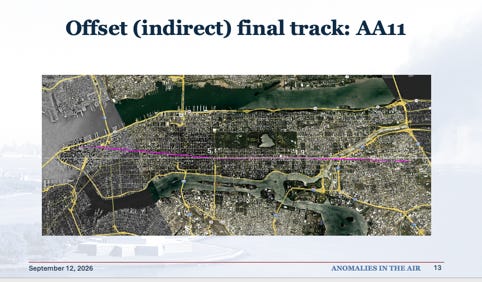
SLIDE 14
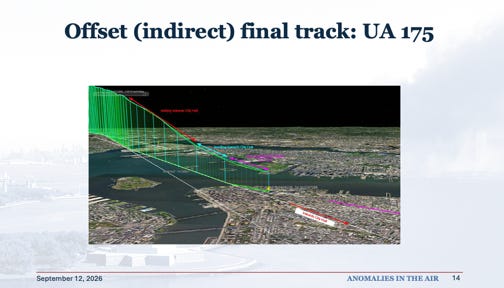
The central issue here is not whether they could fly this way, but rather would they fly this way?
From a pilot’s perspective, these are unnatural approaches to take and, in a study by IC911 involving simulator runs with qualified pilots, it was found that pilots naturally lined up with the South Tower when tasked with flying in order to hit it. It was also found that, even when instructed to fly an offset, pilots often started to turn the plane back towards a direct path. In short, the offset indirect approach was an unnatural and counterintuitive one for pilots to take.
I’d add that this is not an extraordinary proposition or finding, that when trying to maneuver a machine of any kind in order to hit something, that you would naturally do so by aiming directly towards it.
The second thing we know is that these offset-indirect paths into the buildings were corrected, for both Towers, within 10 seconds of the final impact.
Here the issues become one of both would they fly this way – i.e. fly the offset until the aircraft was within seconds of the building – and could they actually pull off the last second maneuver needed to finally line the aircraft up with the tower.
SLIDE 15, Play film
For UA175, as you can see in the film showing, the aircraft both pulled out of a steep dive and carried out a mile long 20-degree banking turn that was necessary to hit, and therefore avoid missing, the tower.
This maneuver was carried out at extremely high speed – over 500 kts – whilst American Airlines 11 performed a similar pullout and turn accelerating up towards 375 kts.
These were demanding maneuvers. Objectively speaking, descending turns to meet a fixed point in space, similar although not identical to flying a curved approach to land, require precise control inputs and an understanding of the bank angle and back pressure required in order to achieve the correct rate of turn.
SLIDE 16
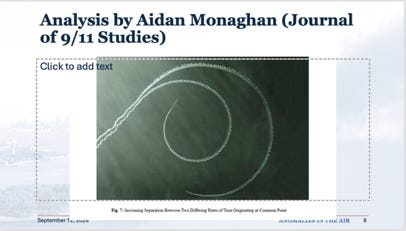
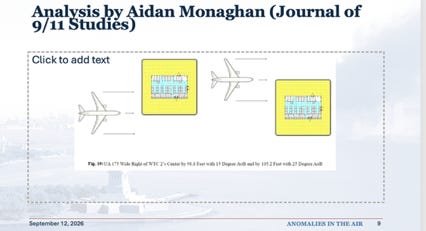
As you can see in slide 16, too high a turn rate and you overshoot the target, too little and you undershoot.
Getting it right also requires knowledge of how quickly the aircraft responds to the controls.
SLIDE 17 Play film
During the IC911 study mentioned before, it was found that even very high experience pilots did notcomplete this maneuver on first attempt, and one example of this from the study is now playing.
Overall, the study established that this maneuver involved precision flying that required prior knowledge of how the aircraft handled at high speed – unavailable to anyone attempting it first time for real – and that one would reasonably expect that the alleged hijacker pilots could not have completed them successfully.
A third set of observations and knowledge comes from examination of the end result of these counterintuitive offset tracks and demanding final maneuvers
First, both aircraft struck at, or near to, a central point in the building and followed tracks that were near perpendicular to the face of the building being hit.
SLIDE 18
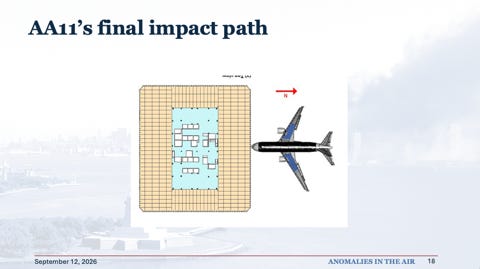
For AA11 this was within one degree of perpendicular as well as dead center, as you can see in Slide 18.
SLIDE 19
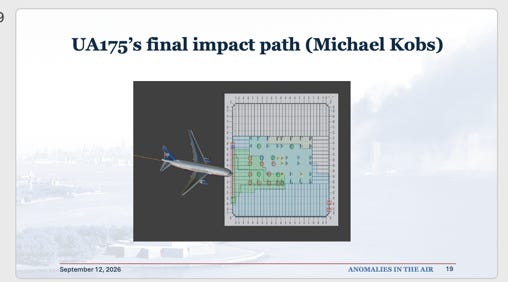
For UA175, the final path, as shown in slide 19, was close to center and only 8-degrees from perpendicular. In addition, the heading changes and final offset tracks in the last two minutes for UA175 were consistent with the aircraft being maneuvered toward this perpendicular track and the center of the building.
Slide 20
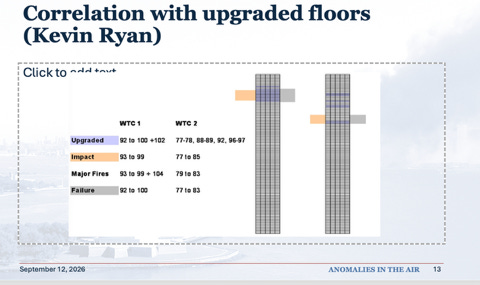
The second consequence of the last second demanding maneuvers concerns the sharp pullouts. These resulted in the aircraft impacting at particular heights which, according to researcher Kevin Ryan, were correlated with floors that had recently had work done on them, purportedly for fireproofing upgrades.
If we now relate these impact points to what we know about the planned controlled demolition of the towers, guiding the aircraft toward a perpendicular track into the centre of the building, thereby ensuring the aircraft hit centrally and fully, would be necessary to create the illusion for the general public of damage severe enough to cause the towers to collapse.
Importantly, the perpendicular and centered track minimised the risk of striking the building at too steep an angle or at a corner, in which case the nature of the resulting impact would have been far less predictable and might have involved insufficient damage.
In addition, creating the illusion of the upper sections of the buildings crushing the lower sections – with the demolitions plausibly planned around designated points of impact – explains the sharp last second dive pullouts that would have been needed to ensure impact at the correct height.
Overall, the unnatural and challenging last-second banks and dive pull-outs were plausibly a function of a terminal guidance system that was tasked with the precise targeting of the building and that “kicked in” during the final seconds.
Drawing upon these observations, what can we infer overall regarding the manual – automated/precision control scenarios?
This sequence of events is difficult to rationalize if the aircraft were under manual control. In this scenario, and as evaluated during the IC911 Study showing pilots flying directly towards the buildings, the aircraft would have flown a direct path rather than an offset one.
Moreover, and based on our evaluation of the challenging final maneuvers during the IC911 study, it is reasonable to expect hijacker pilots to have failed to complete them.
Finally, the likelihood of two manually flown aircraft both ending up pulling out of steep dives and maneuvering towards perpendicular tracks and central points in the buildings – having flown indirect-offset routes to within 10 seconds of impact – would be very small.
By contrast, the observations fit well with an automated control scenario in which computer-assisted guidance managed demanding maneuvers and directed the aircraft in their final seconds toward specific tracks and impact points in the center of each building and at specific heights.
Taking into account our knowledge of the planned controlled-demolition of the towers, these specific impact points can be explained by the need to help build the illusion that the aircraft impacts were the cause of the subsequent gravitational collapse of the buildings.
Finally, the fact that this pattern of counterintuitive and difficult manuevers, combined with maneuvering toward perpendicular lineups, is observed twice, i.e. for both American Airlines 11 and United Airlines 175, further increases our confidence in the automated control scenario.
Slide 21
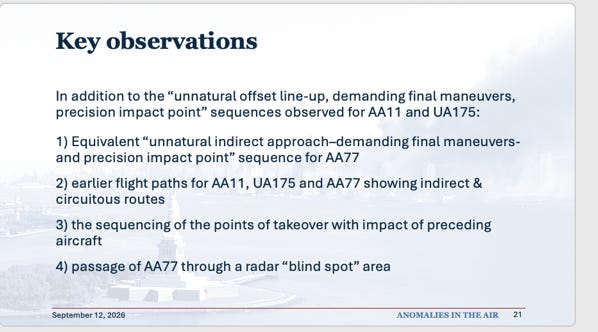
In addition to the “offset – Maneuver – impact” sequence just discussed, other observations are also available with which we can discriminate between the manual and automated scenarios. Due to time I can only briefly mention these.
These include:
First) a similar “ offset – maneuver –precision impact” sequence for American Airlines 77 which purportedly hit the Pentagon: This increases to three the number of times the same sequence, consistent with automated control as I have just explained for UA175 and AA11, is being seen here on 9/11.
Second) earlier stages of the flightpaths for the aircraft which show indirect – circuitous – flight paths consistent with automated/remote and not manual control.
For example, AA11 headed on a north-westerly track away from New York for many minutes before turning toward the city. UA175 flew much further to the south west than was necessary before turning back towards New York. Under the manual scenario, you would have expected hijacker pilots to minimise risk of interception, or getting lost, by flying straight to the targets promptly.
Third) the sequencing of the times at which the aircraft were commandeered, with takeover immediately preceding the impact of the previous aircraft on three separate occasions. This is an unlikely scenario if the planes were being flown by four separate teams of hijackers who had no way of communicating with each other
and
Fourth) the likely not coincidental passage of AA77 through a radar “blind spot” area just as the aircraft went off track and which ensured ATC controllers lost sight of the plane as it headed back towards Washington. I’ll be discussing this in a little more detail in the next section on air defence trip points.
These four observations all provide further support for the automated/remote/computer assisted scenario.
Summing up this section on the control of the flights:
The observations discussed here provide clear and consistent information in support of the automated scenario in which the aircraft on 9/11 were under some form of automated control involving remote and computer assisted precision guidance. In doing so, they raise substantial doubt about the official claim that the aircraft were piloted by hijackers.
SLIDE 22
Over the years much has been made of the US air defence response to 9/11 and the interaction between FAA air traffic controllers and the US DoD.
For critics of the official narrative, the fact that no US fighters were able to come close to intercepting any of the airliners as they were flown towards the Nation’s key eastern cities over the course of an hour, is implausible: some kind of stand down order or plan to obstruct interceptions must have been implemented, so the argument goes.
Whilst the 9/11 Commission broadly concluded that those responsible in the DoD and FAA were caught off guard, albeit with some indication of blunders being made, there are a number of prominent issues unresolved by the Commission with respect to the air defence response.
SLIDE 23
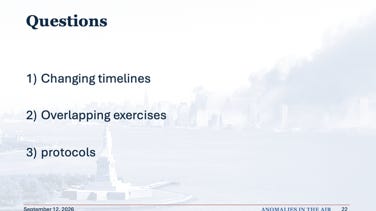
One key strand of criticism concerns the changing official timelines about who knew what and when.
For example, immediately after 9/11 senior US military officials claimed that no fighters had been scrambled until well after the Towers and Pentagon were hit. This timeline was then quickly revised to assert that fighters had been launched in response to American Airlines 11, United Airlines 175, and American Airlines 77, but that they had failed to reach the commandeered aircraft in time.
Come the 9/11 Commission, it was then argued that fighters were launched only with respect to AA11 and that the US air force had no advance warning of either UA175 or UA93, and hardly any for AA77. The 9/11 Commission chastised senior military officials for their initial “inaccurate” claims.
Another strand of criticism focuses on the fact that there were multiple training exercises being conducted that day. The argument has been made, and can be made, that these were an integral and deliberate part of confusing both the military and the civilian air traffic controllers.
Finally, some have highlighted the role of protocols. One argument here is that the existing protocols appeared to have created a laborious and slow response whereby authorization of scrambles was delayed due to requirements to gain permission from higher authorities. Another argument is that the FAA controllers and their military counterparts failed to follow protocols.
All of these lines of criticism of the official excuses for failure to intercept are relevant. However, a close analysis of the events, based upon available ATC communications, flights tracks, and military communications, also allows us to identify of possible “trip” points which disrupted the air defence response.
And by this I mean points at which there were key failures to act or improper actions and which are accompanied by unpersuasive or unclear mitigating explanations.
Today I have time to outline four such trip points which are currently being evaluated.
SLIDE 24
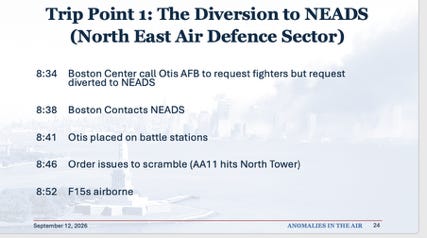
Contact was lost with American Airlines 11 at 8:13 but it was not until 8:21 that controllers became alarmed as the aircraft transponder was also switched off. By 8:24 controllers at the Boston Center assessed that the aircraft had probably been hijacked – the radio communication, allegedly by Atta, had been heard, Ong’s call to American Airlines ground staff had been made, and the aircraft was far off course.
Another ten minutes passed before one of the Boston controllers, Dan Bueno, as AA11 headed toward NYC, contacted the US air force base at Otis and requested fighters to be scrambled.
The crew on alert immediately rushed to their aircraft. If launched promptly, there would have been an outside – theoretical – possibility that they could have reached NYC as AA11 approached the North Tower at around 8:46. They could certainly have reached NYC in time for UA175 which hit the South Tower at 9:03.
At this point, however, there was a critical delay. It is unclear from interviews and recordings exactly who was responsible, – Possibly FAA military liaison Colin Scoggins at Boston Center or possibly OTIS tower itself – but the scramble request was diverted to the North East Air Defence Sector (known as NEADS): The request for fighters allegedly had to go through them first.
This delay became critical. NEADS does not appear to have been contacted until 4 minutes later, at 8:38. With Colonel Robert Marr and NEADS officer Nysypanny in charge, rather than the fighters being scrambled, they were put on battle stations at 8.41. The actual scramble order was not made until 8:46, the time at which AA11 impacted the North Tower.
In short, a full 12-minute delay was introduced by this diversion to NEADs and guaranteed that no fighters could ever reach AA11 in time.
SLIDE 25:
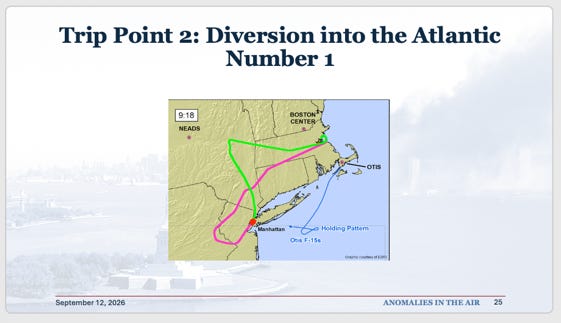
As the two Otis F15 fighters, launched in response to American Airlines A11, became airborne they were directed toward New York. Taking off at 8:52, a full six minutes after the order to scramble, there was, again, an outside chance they could have reached NYC in time for the inbound UA175 approaching from the south west.
However, the aircraft were instead reportedly directed out into the Atlantic and, at the point UA175 hit the South Tower, were over 70 nautical miles away over the Atlantic.
So far, it has not been possible to clarify exactly who issued this order and there are contradicting claims. Specifically, one of the fighter pilots states he continued toward the New York area whilst a NEADS commander claims they were being directed to just south, about 10 miles, of NYC. Commander Robert Marr states they were directed out into a military hold area in the Atlantic.
The end result of this direction – or misdirection – was that any possibility of the delayed F15s being anywhere near UA175 was eliminated entirely.
SLIDE 26:
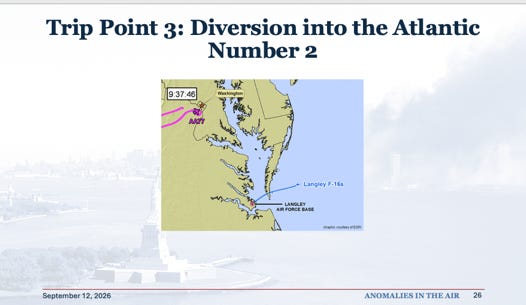
Approximately half an hour later, fighters were scrambled from the Langley Air Force base in Virginia. At the time, it was purportedly because of a report, relayed by Boston’s Colin Scoggins, that AA11 had not actually crashed into the North Tower but had continued its flight and was heading toward Washington D.C.
As this was occurring, AA77 was heading back toward Washington, undetected by FAA air traffic controllers.
As with UA175 and the fighters originally scrambled to intercept AA11, there was an outside chance the Langley fighters could have reached the Washington area as the plane designated as AA77 headed toward the Pentagon.
However, any possibility of this was entirely eliminated because, due to purported confusion over heading instructions and the failure of NEADS to actually look at and track the fighters they had just ordered to be scrambled, the fighters were sent due east out over the Atlantic Ocean.
The F16s ended up being 150 miles away from Washington when the Pentagon was hit.
Slide 27
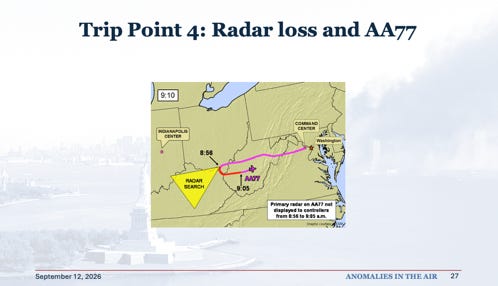
The plane designated as AA77 was not being tracked by Indianapolis ATC for almost half an hour as it headed back into Washington. This was because the FAA air traffic controllers had not only lost radio and transponder contact, they also could not see the aircraft on radar at all. The primary radar return had been lost just as the aircraft started to turn south and you can see this on slide 27.
Other radar stations were allegedly still tracking the aircraft, but the specific radar station from which data was being fed to the controllers at Indy Center was reportedly one that did not function adequately in this area.
That same radar did start to pick up the aircraft about 9 minutes later, but by this time the aircraft was almost one hundred miles east of where it had last been seen, and controllers assert that they did not spot its reappearance.
For the planners, this loss of radar tracking was essential to avoid mission failure. If the FAA air traffic controllers were able to see AA77 turn back and head towards Washington, they would have been able to alert both the Washington controllers and NEADS.
In a scenario where two aircraft were already known to have been hijacked and then flown into the Twin Towers – which was certainly the case at this point – this information would have demanded an air defence response with fighters directed to intercept AA77 as it reached Washington’s airspace – there would have been about half an hour for this response to have occurred.
We can infer from this that the continued westward elongated track to reach the radar blind spot may have been planned. If the aircraft had turned a little sooner or a little later, ATC would have seen it.
This is a likely explanation for this suspicious turn right at the radar blind spot.
The only other potential explanation for this blind spot turn would be to accomplish a plane swap without being observed. This possibility will be evaluated in due course, but time does not allow for that discussion here.
Review of records of witness interviews and records of the 9/11 commission provides grounds to question what we have been told. Some controllers assert they were unaware of this blind spot, reportedly being told about it only a week or so later. No detailed explanation is given as to why the problematic radar had never been fixed, and no rationale is provided as to why it was unable to detect an aircraft at high altitude (away from any ground clutter caused by, for example, mountains).
Now, OK, there are further areas of inquiry which I do not have time to go in to and these include the fog of war issues relating to the erroneous reports about the “Phantom AA 11”, the hijacking of Delta 1989 hijack/bomb (communicated by Scoggins), and the matter of intentional “fog of war” deceptions. But no space for this today.
So, summing up what I have covered today regarding the air defence response:
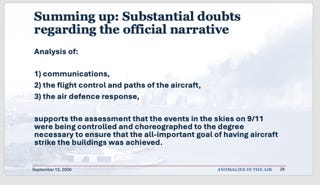
A series of possible “trip points” are clearly identifiable, none of which have satisfactory explanations based on what we know from interviews and official reports. They all require further investigation as possible points at which the air defence response was intentionally disrupted and, along with the further areas we are looking at, provide substantial grounds to question the official narrative regarding the air defence response.
SLIDE 28
So, to conclude the presentation:
The official 9/11 narrative is based on the ideas of hijackers seizing control of and flying the planes, communications from on board the aircraft explaining these events, and the US air defence system blundering as it was caught off guard by a surprise attack.
There is, however, substantial doubt regarding this narrative.
I noted at the start that the planners of 9/11 would have needed a high level of certainty that the aircraft would impact the buildings in which explosives had been pre-planted.
Without that mission goal being achieved, the complete destruction of the buildings would have been inexplicable and have led to “mission failure”, either through abandonment of the entire operation, or because of a rapid public realisation that someone had had sufficient access to and control of the buildings to blow them up.
The information discussed today provides support for the case that the requisite level of choreography was indeed attained, and that this was through the planners of 9/11 controlling and managing both the aircraft and the air defence response.
Thank you.
Excellent, detailed analysis that is useful for further investigation should a grand jury or some other body attempt it.
Thank you Piers. I really appreciated your presentation in New York. On the question of whether any of the alleged hijackers actually flew the planes into buildings, I concur that it's highly unlikely the plotters of 9/11, who had arranged for the twin towers to be demolished in a very specific and visually dramatic way requiring a cover story of planes hitting them at a precise location and manner, would take the chance of having inexperienced suicide pilots, no matter how much they might have been indoctrinated or trained, try to execute these aviation maneuvers. Especially when remote-control technology was available to the military intelligence complex at that time.
Furthermore, there is essentially no evidence that any of the alleged hijacker pilots boarded any of the 4 planes, as Alan Merrill showed in his presentation right after yours.